

What Is the 50-30-20 Budget Rule? A Simple Guide to Smarter Budgeting
Many consumers like to have guidelines for budgeting and other financial planning decisions. They want to know how much to spend, how much to save, and even much how they should withdraw in retirement (for example, one rule suggests spending 4% of savings each year). There are guidelines for investing in stocks and for earning returns on savings. Some of these guidelines have catchy names, and others use numbers to make it easy to remember.
Budgeting rules are popular because they simplify decision-making. Instead of tracking every dollar immediately, they offer a framework people can understand and apply quickly. For consumers who feel overwhelmed by budgeting, starting with a simple guideline can feel much more approachable than building a detailed financial plan from scratch.
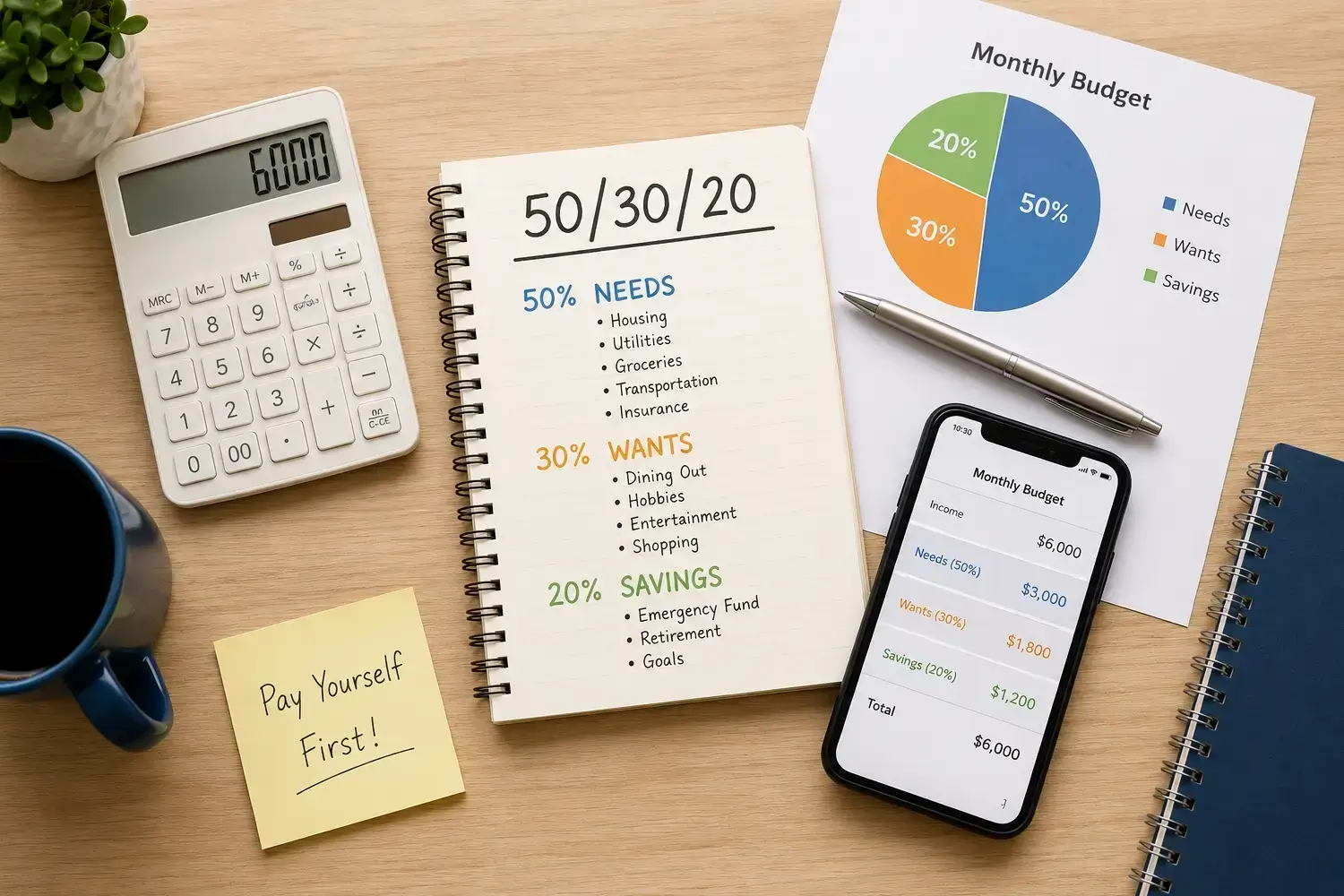
One of the more popular budgeting guidelines is called the 50-30-20 rule. The idea is simple: consumers should plan to spend 50% of their income on needs, 30% on things they want, and 20% on savings.
Why Budget Rules Work
Budgeting rules like the 50-30-20 framework are popular because they simplify financial decision-making. Instead of feeling overwhelmed by tracking every expense immediately, consumers can begin with a straightforward framework that provides structure and direction. While no budgeting method is perfect for every household, having a starting point can make financial planning feel much more manageable.
50-30-20 Budget Calculator
Enter your monthly take-home income to see how the 50-30-20 rule could work for your budget.
This may have become popular because it works well for many middle-class earners. For example, if you have $6,000 a month in take-home pay, you should likely spend around $1,500 on rent, $400 on utilities, and $600 on transportation. That would leave $500 for food and medical care, bringing the total to 50%. Then you would have $1,800 for all the other things you want to buy, including clothing, haircuts, gifts, and pet care. And you could then put the remaining 20%, or $1,200, into savings. $600 could go into retirement savings, $300 into emergency savings, and $300 into special savings accounts for things like education, a down payment on a home, or a vacation. The amounts fit almost perfectly!
What counts as a need vs. a want?
One of the biggest challenges with the 50-30-20 rule is deciding where certain expenses belong. Needs generally include essential expenses such as housing, utilities, groceries, transportation, insurance, healthcare, and minimum debt payments.
Wants are typically nonessential expenses such as entertainment, dining out, vacations, streaming subscriptions, upgraded phone plans, hobbies, and impulse purchases.
Some expenses may fall into a gray area. For example, internet service may be essential for someone working remotely, while a gym membership may feel necessary for health and wellness. The important thing is to categorize expenses honestly and consistently. Of course, this formula doesn’t work for everyone.
For example, people with large amounts of unsecured debt need to account for those payments somewhere in their budget. Since debt payments are obligations, they typically fall into the “needs” category, making it difficult to keep expenses under 50% of income.
Likewise, people with higher incomes may not need 50% of their income for needs, which is a great problem to have. And people with very low incomes or large families may not be able to handle all their needs with just 50% of their income.
So people may ask, “What can I do if my needs cost more than 50% of my income?”. The answer is, try to get close. Do 55-25-20 or even 60-20-20. But try to avoid 60-30-10 or anything that reduces savings.
The most important part of the 50-30-20 budget plan is the 20% for savings. In fact, 60-20-20 works almost as well, but limiting the wants category can make day-to-day living more challenging. The key to almost every budget plan is to save at least 20% of your income by carefully controlling your spending.
Why the 50-30-0 Budget Sometimes Fails
Even with a solid plan, budgets can break down for reasons unrelated to poor spending habits. Rising rent, unexpected medical bills, car repairs, childcare expenses, and inflation can all disrupt even the most disciplined budget. In other cases, the issue may be lifestyle creep—where spending gradually increases as income grows. A bigger paycheck doesn’t always translate into bigger savings if spending expands to match it.
Consumers who can’t save at least 20% of their income might want to write down their expenses in the needs, wants, savings format to see what the problem is. It is usually easy to see whether shelter costs are more than about 30% of take-home pay or a car payment is more than about 15%. Those are the usual culprits because they are the big-ticket items, but a spending problem can be anything, and it is important to identify the problem so it can be addressed.
Identifying and solving a budget problem may feel overwhelming, but you don’t have to figure it out alone. Take Charge America’s certified nonprofit credit counselors can help you review your budget, understand your options, and create a personalized plan that works for your financial situation. Whether you’re struggling with debt, trying to build savings, or simply looking for a clearer path forward, getting expert guidance can make all the difference.
Take Charge America offers free credit counseling to help you review your full financial picture and understand your options. If a Debt Management Plan makes sense for your situation, a certified counselor can explain how it works and what it could mean for your monthly payment and payoff timeline.
Call 877-357-6309 or get a free online estimate to see whether you could lower your monthly payment and save on interest.
Frequently Asked Questions About the 50/30/20 Budgeting Rule
What is the 50/30/20 budgeting rule?
The 50/30/20 budgeting rule is a simple budgeting method that divides your after-tax income into three categories: 50% for essential needs, 30% for discretionary wants, and 20% for savings or debt repayment. It provides an easy framework for managing money without creating a highly detailed budget.
Does the 50/30/20 budgeting rule work for everyone?
Not always. While the 50/30/20 rule is a helpful starting point, your ideal budget depends on your income, cost of living, debt obligations, and financial goals. For example, if housing costs are high, your “needs” may exceed 50%, requiring adjustments elsewhere.
Is the 50/30/20 rule based on gross income or net income?
The 50/30/20 budgeting rule is typically based on after-tax income (take-home pay) rather than gross income. This helps create a more realistic spending plan based on the money you actually have available each month.
What counts as needs in the 50/30/20 budget?
Needs are essential expenses required for daily living. These may include:
- Rent or mortgage payments
- Utilities
- Groceries
- Transportation
- Insurance
- Minimum debt payments
- Childcare
- Healthcare costs
What counts as wants in the 50/30/20 budget?
Wants are non-essential lifestyle expenses that improve quality of life but are not required for survival. Examples include:
- Dining out
- Streaming subscriptions
- Vacations
- Shopping
- Hobbies
- Entertainment
- Premium memberships
Does debt repayment count in the 20% savings category?
Yes, extra debt payments beyond the minimum are often included in the 20% category alongside emergency savings, retirement contributions, and other financial goals. If debt payoff is your priority, you may choose to allocate more than 20%.
What if I can’t save 20% right now?
That’s okay. Many households face high living costs or unexpected expenses that make saving difficult. The 50/30/20 rule is a guideline, not a rigid formula. Even saving a smaller amount consistently can help build financial momentum over time.
Is the 50/30/20 rule good for paying off debt?
It can be, especially if your debt is manageable. However, if you’re dealing with significant credit card debt or financial hardship, a more aggressive debt repayment strategy may be more effective than a general budgeting framework.
How can Take Charge America help with budgeting and debt?
Take Charge America offers financial education, budgeting resources, and credit counseling services designed to help individuals better understand their finances, create realistic budgets, and develop personalized debt repayment strategies.
Related Posts

7 Ways to Save Money on Dorm Room Essentials
Sending your college student to live in a dorm or college apartment for the first time is exciting, emotional and…
Read More
5 Awesome Summer Jobs for Teachers
If you're a teacher, you know summer vacation isn't the life of luxury many people assume it is. In fact,…
Read More
Why Do Creditors Close Credit Cards Without Notice?
Have you ever tried to use a credit card, only to discover it's been closed without your knowledge? Or checked…
Read More